(Actually our shop!)

(Actually our shop!)
visit www.zazzle.com/LarksWorld

Daze Cache: 9/19/17 - Head Counts

Good Day, All! All seven of the monarch butterfly caterpillars have disappeared overnight, perhaps due to same as the half dozen in the back forty; no sign of chrysalis thingies this time. BUT, I had fun with a Painted Lady Butterfly. I hope you enjoy the closeups of its eyes and stuff but, too, there's a lesson to be had that it turns its back on lifeless resources and goes from one feast to another - and isn't life full of them? Scope 'em out...


Meanwhile, several chipmunks (including our Stonewall from last year) are cozying up to us (and the seed tin) of late, comfortable enough to turn their backs on us for a nice long draw from the brook.


The large set of red squirrels have all but disappeared; this one having been victorious, albeit a little muddy around the beak, for having found great pine cones to stash (I'd tell you where along that sharp edge of the brookbank's corner under the old muddy stump, but he swore me to secrecy - would YOU want to betray a face like this? I think NOT!)


The chipmunks have done much barking about aerial predators, mostly having to do with the marsh hawk (larger) that'll swoop along the brook, but also (now) an immature sharp-shinned hawk who easily flops about tree limbs like the robins and blue jays, just pretending to be 'part of the gang' since he's similar size.

But, no, when the chipmunks are barking AND the robins are giving sharp scolds, all telling the threat "WE see you! Move along and leave us be!", they give up and do. I've even seen an eagle chased off by first a crow then a little pair of kingbirds. I guess few critters stay alive better than heeding warnings of neighbors, joining them, and having a little sense of one's worth.

Take Tiberius, for instance. He owns the road as much as he dares, knows which engines are 'friendly' enough they'll slow and yield to him (but moving in a half crouch ready to spring out of harm's way).
Teddy, on the other hand, seems to prefer the fuller living method of avoiding feeling like a fool and burning more calories in a half crouch by owning the stone walls which line this back road. But who's to say which cat is wiser?

And is their purpose to, truly, be compared with each other, as if there's somehow a 'right' or 'wrong' way to be a cat? I don't think I'd make a good judge, so I'll recuse myself on this one.

PS Here's a new-to-me fuzzy caterpillar; guess it belongs to a Brown-Hooded Owlet Moth which - yes - is as fuzzy and brown/gray mottled on its wings as the name suggests:
But if you think it's something different, please be sure to sing out. Far be it from me to ever be incorrect about anything! ;)

Toodles!

Gwyn (aka "Lark")


Daze Cache: Monarchs and Tigers and Squirrels, Oh My!

We have a Monarch Butterfly caterpillar at the house! (Maybe MORE than one - gotta check the OTHER milkweed plants about the yard!). This may be the third set they do, with maybe more to come in Sept/Oct before that last migrates down to Mexico and Cali and is able to live four to six months (the other three batches only live two to six weeks each).

We've been waiting and waiting for years, and looking and looking for eggs, etc.

Their life cycle is 4 weeks from egg to butterfly: egg hatches in four days, spends two weeks as a 'pillar, then attache to stem or leaf and molts out that colorful cloak and hangs out 10 days.

In that time, its molecules are all scrambled, the body turns to gel, and just 'magically knows' how to rearrange what used to be skin and a bunch of Mary Jane-shoed feet into the classic Monarch.

Its milkweed comrade, the Milkweed Tussock or Tiger Moth caterpillar (fuzzy guy that looks like a calico Pekingese dog) braves our NH winters in a cocoon aided by that 'fur coat'. The young instars (stage of caterpillar between molts) know to avoid the veins of the milkweed leaves; the older ones give the veins a cutting chomp to stop the latex flow to their feeding area.

Wonder where they learned that, with no grownups around to teach 'em sense and skill?

Now, with the nights getting cooler, our one remaining gray squirrel (have seen only one red one, as well) is taking to enjoying a monopoly on the acorns, which we heard dropping near the Observatory. (Actually, in this pic, he seems to be eating a beech tree nut while hanging from his back toes).

I can't prove it, but I have a feeling squirrels are closely related to monkeys. Or vice versa. You tell me. What nuts he forgets about may hatch into treelings next year or serve as forage for deer and bears. 
A she-bear's spring mating this year will only 'take hold' if she puts on enough calories to see both her AND young through a winter pregnancy.

Meanwhile, both the beech trees and the oaks (where acorns are built) will keep their scratchy-sounding leaves until next spring, perhaps acting as "Open" signs for the nuts that may be found all around them, kind of making food easier to find. 
Now, if you'll excuse me, I'll have to make a point to monitor the milkweeds over the next few weeks in between chores and stuff. Hope you're finding cool stuff where YOU are! 
Have a good 'un!
"Lark"

Bring a Human to Work Day: Northern Water Thrush

Hello, chickadees!

I'm so pleased to present a Northern Water Thrush in the first of (what I hope!) will be a series I'm calling "Bring a Human to Work Day", perhaps to gain a little more appreciation on what all goes into making it so we get to enjoy crossing paths with these happy nomads we call birds.

This "thrush" is actually a warbler (why it's escaped being renamed, who can tell?). Since the sexes look alike, I'll go ahead and name this one "Micah", just for giggles.

Today's our first sighting of Micah since her return from wintering in Puerto Rico, though she could've crossed the New Hampshire border weeks ago, following the thawing ice in flat streams. With the thaws come access to fallen leaves underfoot, where all sorts of bug larvae hide.

Last year, I only saw her make her way at a distance, and only one time. Today, though, I like to pretend she recalls we just like to swing our "eye box" (camera) her way without trying to approach, to explain her being content to carry on with a day at her "office", the brook downhill from the house.

Here she is, looking a little coy, or maybe just giving her neck a good stretch before resuming her food gathering.


Bingo! Tasty little morsel!

She went stock still for about a minute, to my advantage! Normally, her tail bobs up and down as she walks.


I learned a lot about life watching her. 
Sometimes the hunt includes getting a face full of water...

sometimes a current will loose our footing...

other times, we have to just wade right in in search of the prize...

Many, many times it takes muscling obstacles out of the way...

as well as twisting and stretching our "all" to get things done!
And it's like all of nature agrees that just "being" and "doing one's best" is all the good and proper needed, leveraging what we know about opportunities in their seasons, good places to be for the most sensible comfort, among many other things.

Of all the places Micah could've settled, I'm glad it's right here and that she let down some of her wylde guard enough to not let us get in the way of her "be-ing". Of course, when you're a little winged thing and brave tropical storms and wintry mixes, people like me must seem like peanuts.

Still, studying the Art of Being a Bump on a Log has its advantages, and I've had a LOT of years of practice - nearly half a century!

Well, I'll sign off for now, chickadees, and see if I can get you another critter for the next "Bring a Human to Work Day".

Stormshines

There once was this awful ice storm that kept coating tree limbs with such heavy ice that they not only broke off and fell but many whole trees were uprooted altogether, days and nights filled with popping, cracking and slamming sounds in forests and in towns.

Those with chainsaws and winches traveled about to help clear these trees that blocked roads, making it so no one could go about their work to support their families. In this town where we live, there are many "old families" who've lived here for generations. Most lived in harmony, as you'd imagine, but here were a couple who'd carried on with feuds not unlike the Hatfields and McCoys, short of violence.

One day, a massive tree blocked a public road, and there was no going over it easily even climbing, nevermind around it with a vehicle. And it wasn't going to move itself.

To my amazement, two members of a feuding family came to it at the same time, each wanting to get to the other side. Each had a chainsaw and knew just what to do to slice into that barrier, bit by bit, to move it out of the way in any way they could manage. Extra hands would make lighter work of it, but there was no way to call for help back then. They were on their own.

Each man eyed the other, having no little dismay at being forced to lend their tool and fuel to the other on this task. Their eyes locked in this understanding of mutual resentment.

But then their gazes softened to reason and yielded to their willingness to do the right thing of setting aside their emotions, at least long enough to tackle the greater priority of freeing access for their own friends and family and selves, and the pride of doing it well and quickly, in honor of the good men who taught them. Perhaps a little spirit of competition, too, was at play in feeling motivated to show off some of these skills and best the other at the same time.

VRRROOOOM VRRROOOOM VRRROOOOMMMMMMMMMMMM! the saws burst to life, chains spinning! In the wrong hands - or with wicked intent - a person could lose a limb. Accidents can and do happen, and no one's gone to jail for such yet because no one would be the wiser. Or so the temptation might say.

Another moment of eye contact put that temptation to rest: Just live, and do this thing in peace, and get on with life in one piece. A gentleman's unspoken contract, and a sacred one.

BWWAAAAAAHHHHHMmmmmmmmm...BWWAAAAAAHHHHHMmmmmmmmm...Each took the opposite end of the tree to free up the weight of the middle where there was no hard road beneath to dull their chains. Those freed, they came in from the ends toward the middle, slicing straight through the obstacle as far as they could until sense and common experience halted them. One was willing to climb to the other's side of the log, and joining strength, they rolled it to expose the final cuts needed to finish that stage of the task where the now-smaller parts could more easily be rolled or lifted and tossed off the road and out of the way.

Later, someone might come to collect the log sections to make them smaller and let the sun and wind season them and make them dry enough to put in a stove to heat their home the next winter. For now, they were pleased it took less time to be successful than it would've had they put their efforts to screaming their laundry lists of differences and reasons they don't want to do the work.

The only sound that came next was the slamming of two truck tailgates after chainsaws, oil and wedges were put away and the men resumed their days. As they got back behind their steering wheels and started their engines to continue heading in opposite directions, they exchanged one last glance of appreciation for respect and help, punctuated by small mutual country "wave" of a few fingers lifted off the steering wheel before heading off forever changed by the fact that what was once thought "impossible" had suddenly been made "possible", their claims of "NEVER!" rendered into "Maybe I WILL try".

There was no demand to suddenly like the other person, but the call to be willing to be part of solutions and peace was awakened as a priority whether they sought them out or cringed at the thought of more incidents like that challenge coming their way.

During that same storm, we were fortunate to have a drinkable brook behind the lodge and a good woodstove for heat. Treeworkers were invited night or day to come in and get warm and have a meal or snack, as it was grueling work in temperatures of twenty below zero at night. My husband became known as "that coffee and donut guy" who brought those and his chainsaw on a little sled down our road. He'd had the wisdom to park our vehicle at the neighbor's who lived at the end of the town maintained stretch; the last half mile was up to us to plow and maintain.

Bill took hot water to that neighbor for washing while they waited for fuel to become available again for their generator; town supplies were short for that ten days of calamity, but cold winters can become a beautiful second language and habit of preparedness. When the power company saw Bill and his sled with comealongs and coffee, prepared to try to move a huge boulder out "our" road inch by inch "come hell or high water, and high water would help", they made quick work of it with a swipe of their heavy duty boom, all the labor lightened by cheer.

I'm sure you are or know a person like that, too, those who never made it to "the news" but are forever recorded in our memories: people who offered power outlets to recharge phones during hurricanes, or climbed over obstacles to deliver urgent supplies, or shared sparse food with a stranger, or gave a little candy to quiet a heart or mind, or simply watched and reported a drug dealer to cops so they might be prevented from further harm.

A life is made as well or as badly in response to such events as storms and threats, moment by moment. And this moment is all we can call our own; we only guess we have a tomorrow.

So, if "there's no greater love than one gives their life for another", could it be that referred not just to heroics in battle but also to lending moments to lift another even if it's the last thing on our list of joys? We were born with our lives; they weren't "earned". Maybe it's worth considering that great successes are possible only by the strength and quality of even the smallest elements that go into them. A tremendous ship is grand, yet without even the smallest rivets that hold it together keeping their strength and form, its rudder would fail to help it go where it steers and its outer cover would fail and it would sink.

Smaller still are the molecules, the tiny mountains, which make up the metal from which the rivets are made; yet look at the wonders possible from being willing to put what little it has to some good use.

Why do I write this? I can't say "no" to doing so; maybe it'll do some small good somewhere to be reminded that there is no love or care "too small" to make a difference, and there's certainly no shortage of opportunities that would welcome it. Nothing has the power to shut the door against a possible "happy ending" to any string of events. So, let's keep finding or making ways to keep the good shining through the darkness, shall we?

Lark out.

Say Hello to Our Little Friend

Since I was able to get a few good shots of the pine mouse, I decided to try my hand at making a gif of it, so let's see if it'll post here!

Daze Cache: Starry Starry Ice

Aarrgh, the COLD!

I know, I know!

But the marvels to behold! You HAVE to go see them, because they can't come visit, and you'll never see them any other time of year!

I'm talking about a couple kinds of ice forming while we sleep!

For instance:
Some determined folks cart Bobhouses onto the lakes, whether the ice is "plenty thick" or not. With I had a closer shot of this, as the house on the right is actually an old skilift tramway car upcycled.

Sabbaday Falls on the Kanc (Route 112) in its usual fine form with icicles two or three times taller than I am. *Don't trek near without crampons - REAL crampons, not the cheap driveway ice creepers that can't bite as well as you'd need. Trust me; tried that on the Oliverian Brook trail and fell so hard my hip was purple for a month.
 Back to happier things, though! haha

"Starry Starry Ice" - some rime ice formed on a stick that was sticking out of the frozen brook surface.

Pretend this one is rotated left, OK? Brook surface with various ice forms.

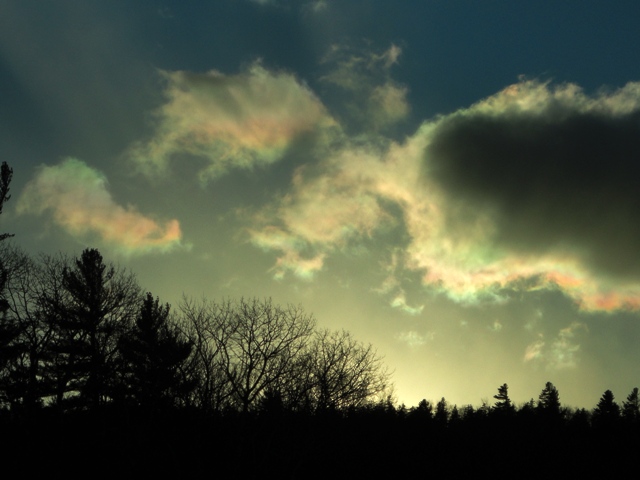
"Where's the ice in this?" you ask?
Why, see the rainbow on the bottom edges of each of the clouds? Those are courtesy of ice crystals up high bending the sunlight "just so".

Be sure to wear protection looking toward the sun, of course. Plus, I couldn't see these without my sunglasses, and put them in front of the camera to help cut the glare to capture it.

Here in central/northern NH, there's still plenty of shape and color going on, even in winter. If you know how, when and where to look.

What do you have around you? Do you know? Find out and tell me!

Have fun!

"Lark"

Woods with a View: The Observatory

For those readers just entering into our seat in the woods, I thought I'd include a couple photos of what we call "The Observatory" set up by the little brook that runs through the property.

As you can see plainly, it's rather high tech: some ropes and a cheap tarp, with an upended broom as a "tentpole" of sorts for more headroom while seated on the cheap foam pad for our boney butts. (*You don't want a sharp stick for the pole, as snow load can force it to poke a hole).

Side view

View approaching from back on trail by driveway; "Island" in center of brook fork, then "Far Ridge" across second fork.

We set up this rig last fall before the temps had a chance to freeze the ground and make it hard to stake the lines, plus to enjoy a dry spot on rainy days when we want to take a break from our labors and just see who's coming to visit. Suet and seeds didn't go out until the bears went to bed for obvious reasons.

Back in the autumn, the turkey moms and juvies (with and without beards), about a dozen total, came down the hill, flapped a couple of times to leap across the narrow brook (which is just barely jumpable for a human, even taller Bill) and made their way up the Far Ridge.

Though we haven't seen them over the winter around here, I did get to spot several the other day. They seem to prefer to give a larger girth to strange things than even squirrels and smaller birds do.


Three turkeys blend with woods and stumps on the Far Ridge.

Mostly, short the rare sighting of the Christmas Mink (first time I saw), we've studied the gray and red squirrels, as well as the white- and red-breasted nuthatches, hairy woodpecker and chickadees, and now about two dozen goldfinches in their winter drab before whatever plants it is they eat in spring bring back their former golden glory.

This is not to say we're not observed, ourselves. Indeed, the Reds continue to study us on the way to and from their own conferences of mewling and chatters to outright skirmishes (usually involving the Island Red encroaching on the stump stashes of those on this side).


Conference


Dime-sized footprints and tiny little claw tracks to give them launch capability on icy snow - SO CUTE!

So there you have it, a little sampling of how we start our day. It's also where we get the only accurate weather forecast for the next few hours; if there's a horde of everything at the seed, storm's coming. If not, they're browsing on other things like some of the many spiders or snow mosquitoes still making their way about or some juicy larvae under the bark.

The chickadees stashed food last autumn like the squirrels did, and they manage to drop their body temp a good 10 degrees from 108 degrees F to conserve heat while they're stuffed in their little hole in a birch tree somewhere, one per hole, only to lose 10% of their weight by morning burning off the fat they gained the day before and stored over their chests. As soon as there's enough light to see trees, they're off getting into their stashes to fuel the daily foraging.

The woods are full of homes and stashes, it seems, whether the trees are rotted or healthy, standing or fallen. Sometimes it's best to include watching our own tracks and impacts.

Have a great adventure!

Til next time,

"Lark" (Gwyn)